Mechanical
Provide component and location details, proposed tooling and the space required for presentation, polishing and transfer. Review the material and geometry range alongside operator, cleaning, maintenance and changeover access.
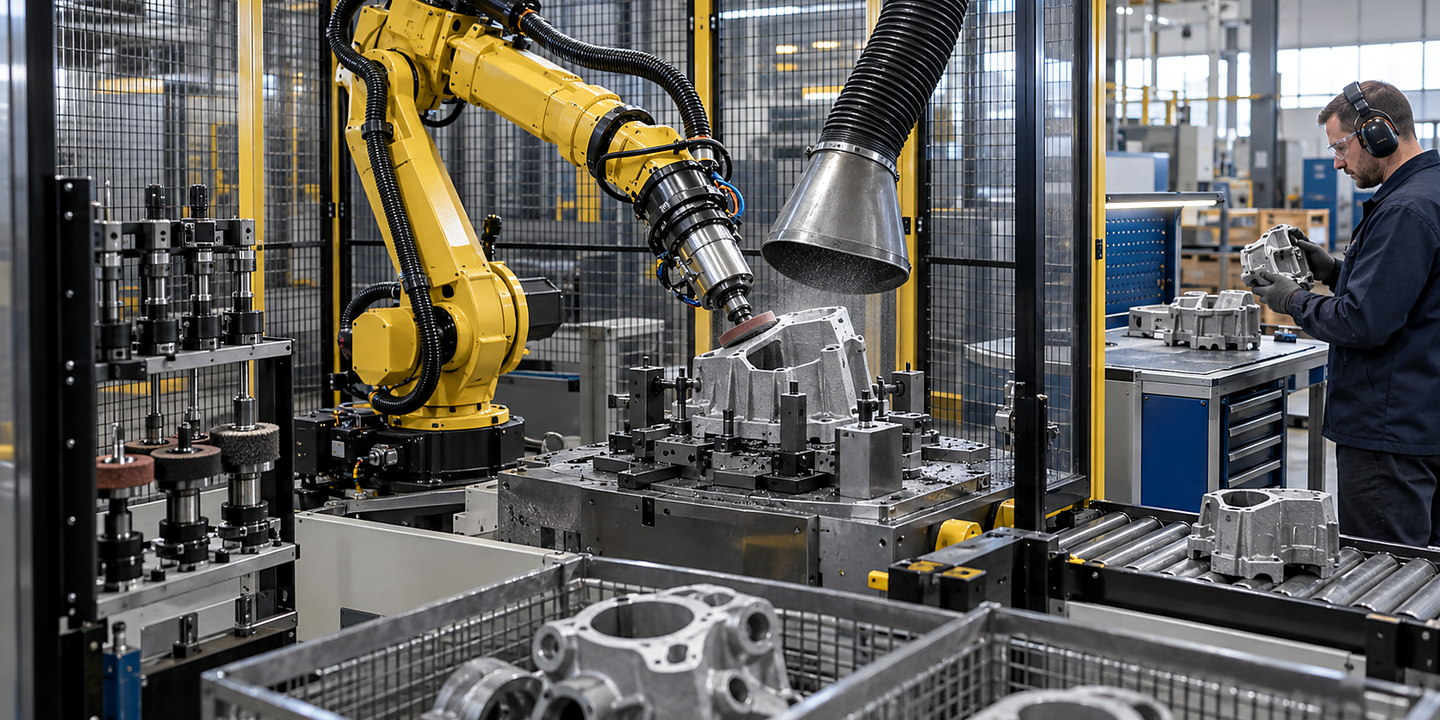
Plan mechanical, electrical, control, data, safety and operator interfaces for robotic polishing cells.
Integrate the component presentation and location, proposed tooling, polishing sequence and appearance check as one process. Define the line states and responsibilities that allow a part to move from one step to the next, including the route for an uncertain result.
Review tool wear, process variation and access alongside those interfaces. The specification checklist can distinguish confirmed connections from items that still need assessment.
Plan robotic polishing cells around your parts, process, cycle time, tooling, recovery and acceptance criteria. Discuss the highest-risk feasibility questions with Oxford Industrial Automation. Your integration review should connect required cycle and production pattern, tooling, sensing and process interfaces and the people who run the process.
Discuss your application

Provide component and location details, proposed tooling and the space required for presentation, polishing and transfer. Review the material and geometry range alongside operator, cleaning, maintenance and changeover access.
For Robotic Polishing Cells, list the supplies, isolation, protective devices, panels and cable routes required by the proposed installation.
Agree the states for component availability, location, process completion, appearance review and downstream readiness. Define the response to interruptions or uncertain conditions and the checks required before resumption.
Review risk controls, stop behaviour, access, reset and the checks needed around tooling, sensing and process interfaces.
Agree what component revision, incoming condition, tool condition, process information and appearance results need to be recorded. Define the reviewer and retention needs without assuming a particular sensing or software system.
Assign responsibility for replenishment, tool checks or changes, appearance review and unresolved parts. Include cleaning, maintenance, training and changeover requirements for the actual component range.
For Robotic Polishing Cells, your team can review each stage before the complete installation is put into routine use.
Share representative parts, process observations and cycle data, including the normal range for part, product and process variation for robotic surface-polishing cells and the difficult arrival pattern and presentation cases.
Compare suitable methods and use focused trials to show how each option performs against required cycle and production pattern.
Connect the equipment to your line, services and controls while resolving tooling, sensing and process interfaces for day-to-day operation.
Confirm operator access, recovery and changeover, then complete and record run-off criteria and production evidence before your operating team takes over.
For your application: check required cycle and production pattern, tooling, sensing and process interfaces, operator access, recovery and changeover, and run-off criteria and production evidence as part of the complete line trial.